


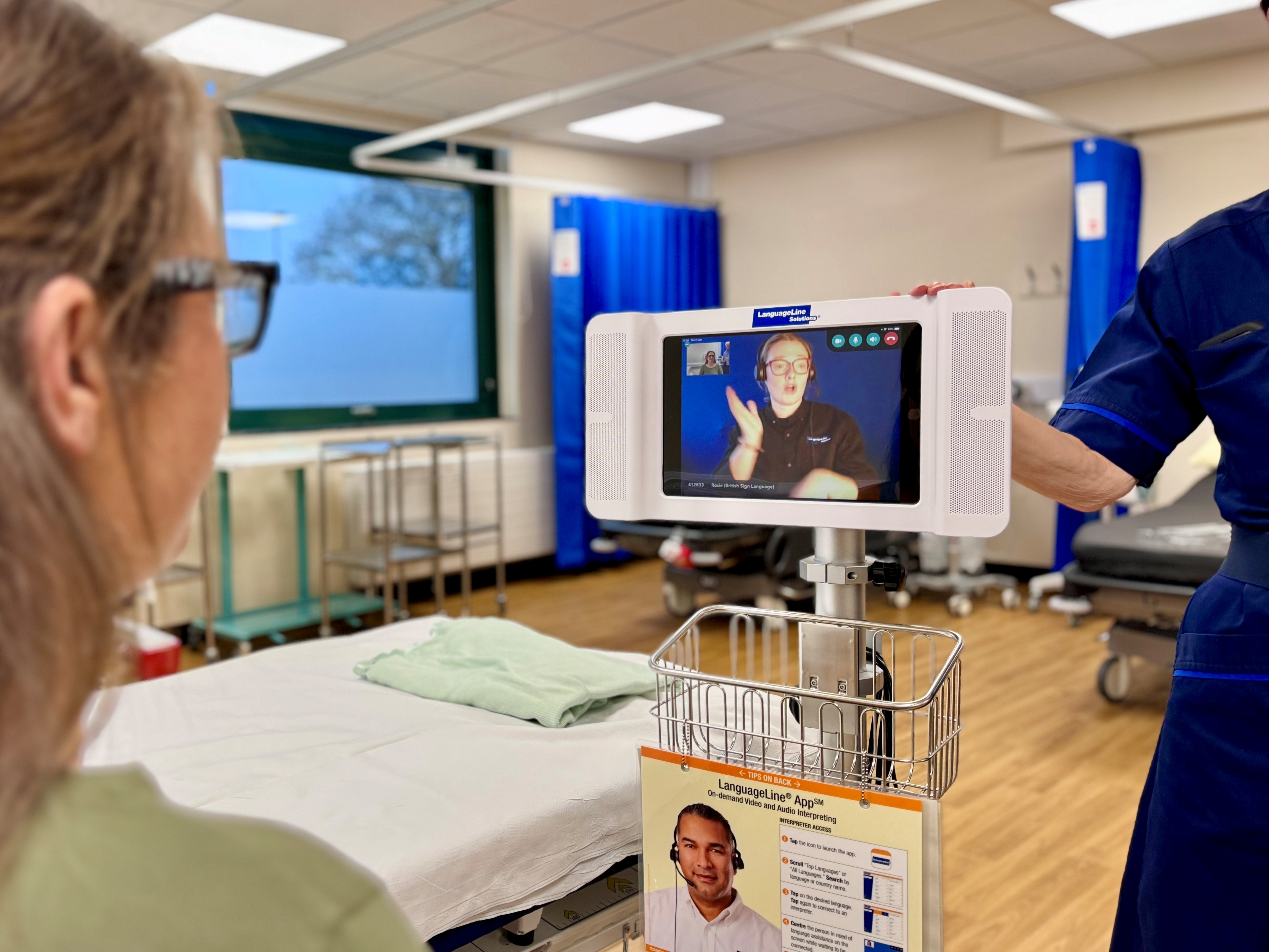
The Language Line service, which was rolled out across the Trust in January, allows access to video and audio interpreters, including British Sign Language, at the touch of a button for patients who are deaf or whose first language is not English.
Appointments at the Trust can sometimes be cancelled due to the lack of interpreter availability as well as those who arrive needing urgent emergency care not fully understanding their condition or treatment. There are more than 240 languages available for an audio call and in excess of 40 languages available for a video call.
Alice Webster, CEO at The QEH, said: “We know that we have had occasions where patients are unable to attend appointments due to the lack of availability of face-to-face interpreters. This ultimately delays their care and treatment and causes frustrations for them and for us who want to help them.
“We needed to make our services as accessible as possible which is why we are the first Trust in the area to be bringing this system into place. This can be used as a positive tool to aid our clinical teams in their care giving process; whether to discuss symptoms, help deliver a diagnosis or just a general wellness check. This will not be used instead of any face-to-face requests that we receive and where this is preferred by a patient, we will always try to facilitate this wherever possible.”
Linda Purdy, Associate Director of Patient Experience said: “Coming into hospital can be worrying for many of our patients and their loved ones. Not understanding a language, including BSL, can make the experience even more daunting and frightening.
“This service has only been available across the hospital for a month and it has already made such a difference. In January we had an elderly Polish lady on one of our wards who didn’t speak or understand English.
“She was clearly very distressed and unable to get out of bed but within a few minutes of a video call with a Polish interpreter she fully understood her condition and how we planned to care for her. It transformed things. Her mood was greatly improved, and within a short while she was able to get out of bed and move around, which is exactly what we needed her to do. Her family were greatly relieved too and the patient went on to make a good recovery.”
The interpreter service is simple to use for staff and patients and includes a search function by country to help locate the best language for the patient. The devices are easy to use iPads that are on rolling stands and have an adjustable height to suit the patient in a standing, seated or laying down position. Importantly the video function can be turned off for privacy.
The British Sign Language option is the most frequently used service since its roll out Anna Pugh, Manager from West Norfolk Deaf Association, said: “This is a really exciting service to provide and will make such a huge difference to patients and their families.”
Ends.
Notes to editors;
For media enquires only, please contact Communications Team, media.enquiries@qehkl.nhs.uk or 01553 613216.
For all other enquiries, please contact QEH Switchboard on 01553 613613.
 QEH Media Hub