


As an Armed Forces Union Flag proudly flew above the hospital, West Dereham Ward patient Eric Garrett took his place in the front row at the QEH’s Sacred Space, wearing a chestful of service medals with his wife Elsie by his side.
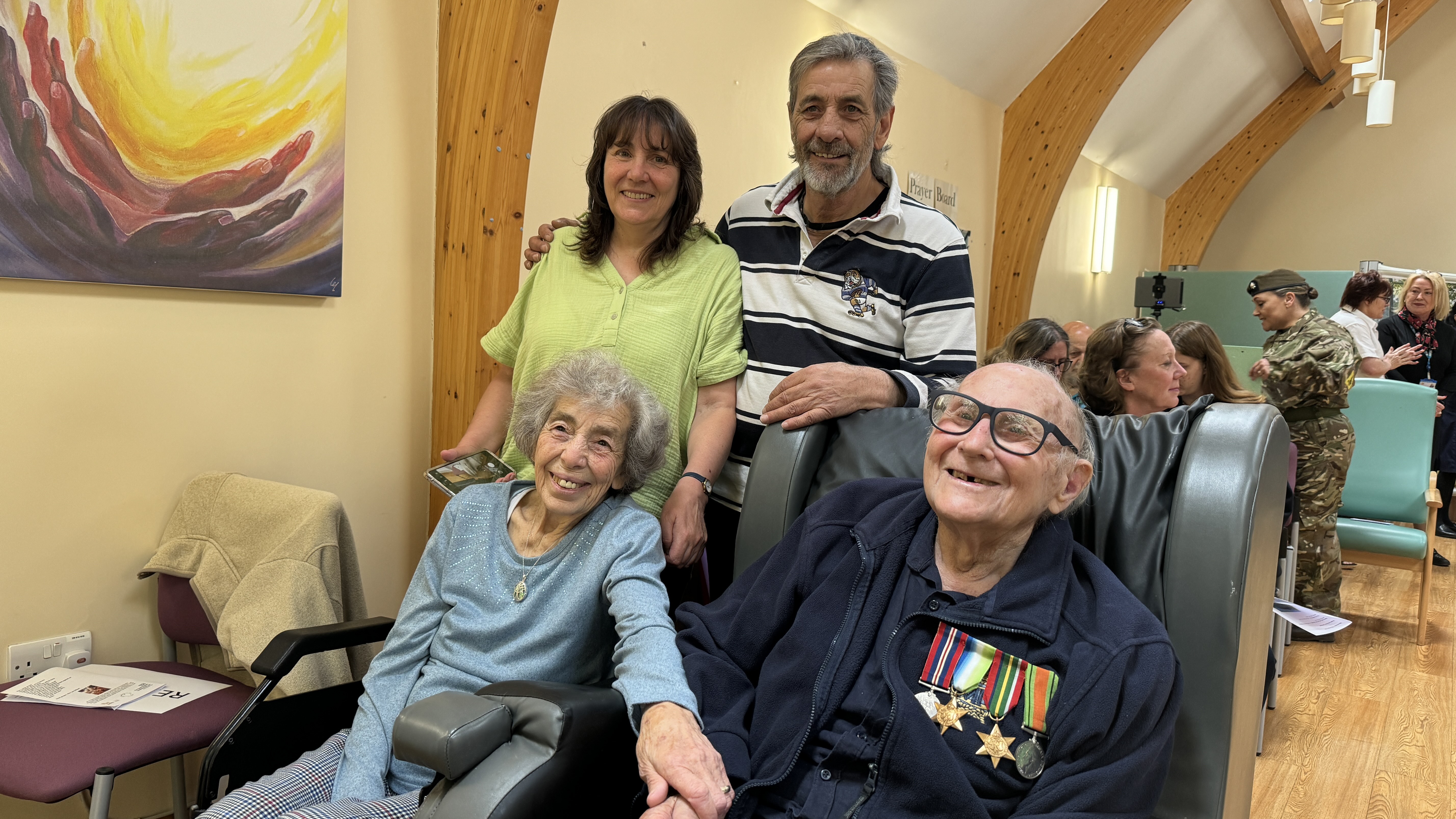
The former publican and milkman from North Pickenham was just 17 when he took part in D-Day – signing up to join the Merchant Navy by borrowing his older brother’s birth certificate.
In the run up to the Normandy landings, the teenager was deployed working with Canadian Allied Forces and was involved in practice runs with landing craft (LCTs) on Hayling Island. It wasn’t until the early hours of 6 June in 1944 that he was to put these skills to use by navigating his LCT as close to Juno beach as possible.
Beach obstacles were already partially submerged, and engineers were unable to clear paths to the beach. The landing craft were forced to feel their way in, and the mines took a heavy toll. Roughly 30 percent of the landing craft at Juno were destroyed or damaged.
Eric’s story captivated attendees at The QEH commemoration who numbered staff, patients, and civic dignitaries including Mayor of King’s Lynn and West Norfolk Cllr Paul Bland, Deputy Lieutenant Nicholas Pratt, Chair of Norfolk County Council Stuart Dark and Lorraine Gore, CEO of the Borough Council of King’s Lynn & West Norfolk.
Sacred Space

The D-Day 80 service, which was live-streamed across the hospital for staff and patients, was led by Rev Lee Gilbert, Head of Spiritual Care, who brought into sharp focus the events of 1944 when so many gave their todays for our tomorrows.
CEO Alice Webster also gave a poignant reading: “As we reflect on the significance of D-Day, we remember the courage of those who stormed the beaches, parachuted behind enemy lines, and fought valiantly in the hedgerows and villages of France.
“The personal stories of these heroes remind us of the human cost of war. Young men, many still in their teens, left their homes and loved ones, uncertain if they would ever return. Some never did. Their sacrifice in Normandy is etched into the hearts of generations who live in the freedom that they secured.
“We also honour the resilience of those who survived, bearing the physical and emotional scars of battle. Their experiences and memories serve as a poignant reminder of the price of liberty and the enduring strength of the human spirit. As we stand here today, we are called to remember not only the past but also the lessons it imparts. D-Day teaches us about the power of unity, the importance of courage in the face of adversity. It is a reminder that the freedoms we enjoy today were hard-won and must be protected.”
Following the CEO’s message, dedicated nurse Pamela Chapman who is the QEH Lead for Palliative Care gave a reading of a specially commissioned poem in her role as a local army cadet leader.
Those attending listened to Vera Lynn’s ‘White Cliffs of Dover’, and sang hymns about peace, accompanied by hospital chaplaincy volunteer, Keith Kirkham, on an electronic piano donated by the hospital’s League of Friends.
Lighting of ‘light of peace’

At 9.15pm, the QEH once again joined a national show of remembrance as beacons and lights of peace were lit around the country.
Outside the main entrance, hospital staff, ambulance crews and patients gathered around a ‘Lest We Forget’ soldier to see the Rev Gilbert with Armed Forces Welfare Officer Michelle Reynolds ignite a lamp representing the ‘light of peace’ that emerged from the darkness of war.
Ends.
Notes to editors; For media enquires only, please contact Communications Team, media.enquiries@qehkl.nhs.uk or 01553 613216. For all other enquiries, please contact QEH Switchboard on 01553 613613.
For the full press pack and images click here.
 QEH Media Hub